
If you need garage door repair service Garland TX can provide on short notice, start with the symptom, not the part. A door that stops, reverses, shakes, or makes a new noise tells you where to look first, and it tells you whether you can check it safely or need to stop using the door at once.
Most common problems at a glance
| What your door does | Likely cause | What to do first |
|---|---|---|
| Lifts a few inches, then stops | Broken spring, or a cable that slipped | Stop using the door |
| Will not close, or reverses | Sensors dirty, out of line, or blocked | Clear the sensor path, wipe both lenses |
| Grinds, squeaks, or rattles | Worn rollers, dry hinges, loose bolts | Listen for where the noise starts |
| Hangs crooked, or sticks | Track out of position, worn roller, frayed cable | Stop using the door if it hangs crooked |
| Remote works, wall button does not | Dead battery, lock mode on, wiring fault | Test both controls, check the lock button |
| Opens on its own after a storm | Surge damage, short in wiring | Unplug the opener if it cycles without input |
| Light comes in under a closed door | Worn bottom seal, bent panel | Check the seal along the full width |
Door will not open, or stops partway
Check power first. Make sure the opener has power, the outlet works, and the circuit breaker has not tripped. A tripped GFCI outlet in a garage can cut power to an opener without any other sign in the house.
Next, test the wall button. If the wall button works and the remote does not, the remote battery, the remote itself, or the opener receiver is the fault. If neither control works, and power is present, the opener motor, logic board, or drive gear may have failed.
If the door lifts a few inches and then stops, look at the spring above the door from the side, without touching it. A gap in the coil means a spring has snapped. A door with a snapped spring feels far heavier than normal. Do not force it. Read about why your garage door will not open before you press the remote again.
Door will not close, or reverses on its own
Safety sensors sit near the floor on each side of the tracks. Each sensor has a small light. When both lights stay steady, the path is clear. When a light blinks or goes out, the opener reads the path as blocked and reverses the door.
Check for objects in the sensor path first. A storage bin, a bike wheel, or a pile of leaves can block the beam. Wipe both lenses with a dry cloth. Dust and pollen in North Texas settle on sensor lenses fast. A bracket knocked loose by a foot or a car door can tilt a sensor out of line by a small amount, and that is enough to break the beam.
Broken springs and frayed cables
Springs carry most of the weight of a sectional door. Torsion springs sit above the door. Extension springs run along each side, above the horizontal tracks. Both types wear with every open and close cycle. When a torsion spring snaps, you hear a loud bang, and you see a gap in the coil.
Springs work as a set. When one snaps, the other has carried the same cycles and the same load. Replacing both keeps the lift even. Sizing, winding, and tensioning a spring carries sudden tension, and that work belongs to a technician. Do not loosen a bottom bracket, unwind a cable drum, or touch a spring under tension.
Cables transfer spring lift to the door. Each cable runs from the bottom bracket up to a drum at the top. Cables fray slowly near the bottom bracket, where they bend and rub. A frayed cable can snap without warning, and a snapped cable drops one side of the door at once. If you see a frayed cable, stop using the door. Garage door cable replacement is a technician job. For spring work, see garage door spring replacement.
Noisy, slow, or shaking door
Noise tells you where wear sits. Grinding usually points to rollers or tracks. Squeaking usually points to dry hinges or rollers. Rattling usually points to loose bolts or a loose opener rail. Popping usually points to a spring or a hinge binding under load. Listen for where the noise starts in travel. Noise at the start of travel points to bottom rollers and hinges. Noise at the top points to top rollers, the opener rail, and the spring area.
Worn rollers cause most noise complaints. Steel rollers wear flat and rust. Nylon rollers run quieter, but they still wear. A roller with a cracked wheel or a bent stem will grind and shake the door as it moves. Tighten only bolts you can reach without removing any part under tension. Do not tighten a bottom bracket bolt, a cable drum bolt, or a spring bolt. Read about why your garage door makes grinding noises if noise is the first sign you noticed.
Off track, crooked, or stuck door
An off track door is easy to spot and dangerous to use. One side sits lower than the other. A roller sits outside its track. The door jams halfway and will not move in either direction. Common causes include a bumper clipping the door, a frayed cable snapping on one side, a roller breaking, or a track bracket loosening over time.
Stop using an off track door at once. Do not pull the emergency release on a door that hangs crooked, because a door without proper spring support can drop. Keep people, pets, and cars clear of the door path. A technician resets the track position, replaces bent rollers, and checks balance before the door goes back into daily use. For track and roller work, see garage door roller and track repair. For the full stuck-door checks, see why your garage door gets stuck halfway.
Opener problems: remote, wall button, motor, and random movement
Test controls in order. Test the wall button first. Test each remote second. Test the keypad third, if you have one. If the wall button works and no remote works, the fault sits in the remotes, their batteries, or the opener receiver. If no control works, the fault sits in power, wiring, or the motor unit.
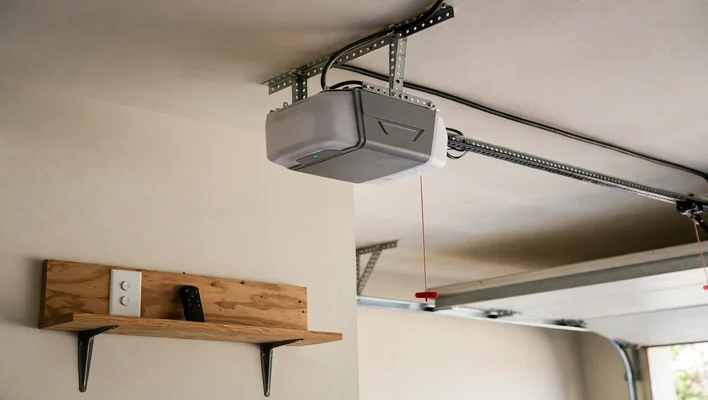
Motor faults include a stripped drive gear, a failed capacitor, a failed logic board, and a worn motor. A stripped gear makes a grinding sound, and the motor runs while the door stays still. A failed logic board can cause random movement or a unit that clicks without input. A door that opens on its own after a storm usually has surge damage or a short in wiring. Unplug the opener if it cycles without input. For opener work, see garage door opener repair.
Panels, weather seals, and gaps at the bottom
Panels dent from car bumpers, hail, and storm debris. A small dent may not affect how the door moves. A bent panel, a cracked panel, or a panel with a broken strut can pull the door out of shape and bind the tracks. Dents at hinge lines affect movement more than dents in the middle of a panel. A bowed panel strains rollers and tracks on every cycle. For panel work, see garage door panel repair.
Safe checks, and repair or replace
Safe homeowner checks take minutes, and they need no tools and no disassembly. Check opener power, the breaker, and the GFCI outlet. Test the wall button, each remote, and the keypad, one at a time. Check the lock button. Clear the sensor path, wipe both sensor lenses, and check that both sensor lights stay steady. Look at springs, cables, rollers, tracks, and panels from the side, without touching any part under tension. Check the bottom seal along the full width.
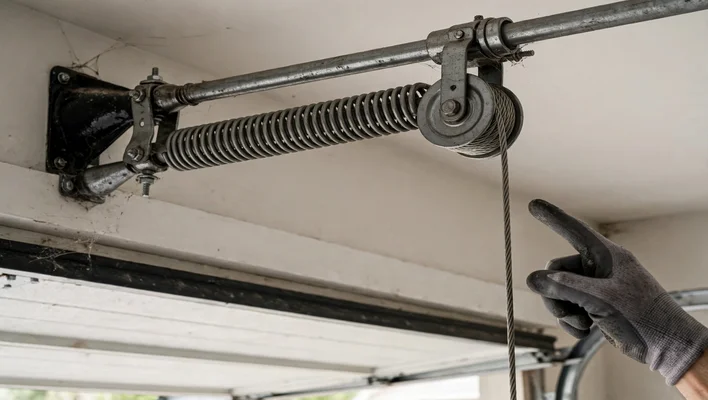
Jobs to leave to a technician include spring winding, spring replacement, cable replacement, cable drum work, bottom bracket work, track position resets on a crooked door, logic board replacement, and any work inside the opener cover. Those jobs carry sudden tension, or live electrical parts, or both. A safe check, a sensor wipe, a remote battery change, and a seal replacement are homeowner jobs. Spring tension is not. If you are unsure whether a check is safe, stop. A door that hangs crooked, drops, or will not stay in place is a stop-now door. Call Now if your door is in that state.
Repair makes sense when one part has failed and the rest of the system is sound. A broken spring on a door with sound cables, straight tracks, and a working opener is a repair. Replacement makes sense when several parts have failed at once, or when the door itself has lost its shape. Several bent panels, bent tracks, a worn opener, and weak springs together point to replacement. For a full new door, see garage door installation.
Garland seasons and preventive care
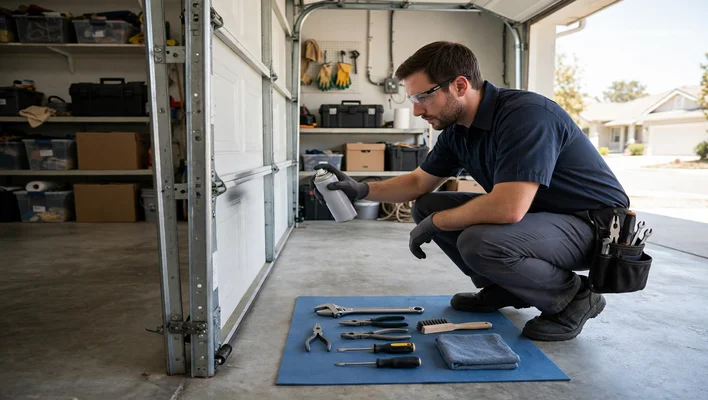
Garland summers bring long heat, dust, and strong sun on south-facing doors. Heat dries out lubricant, shrinks rubber seals, and expands metal tracks by a small amount. Lubricate rollers and hinges with a garage door lubricant, not a heavy grease that collects dust.
Storm season brings wind gusts, power surges, and rain under a worn bottom seal. Homes in Firewheel face the same storm wind risk. After a storm, check the door position, the sensor lights, and the bottom seal before you cycle the door several times.
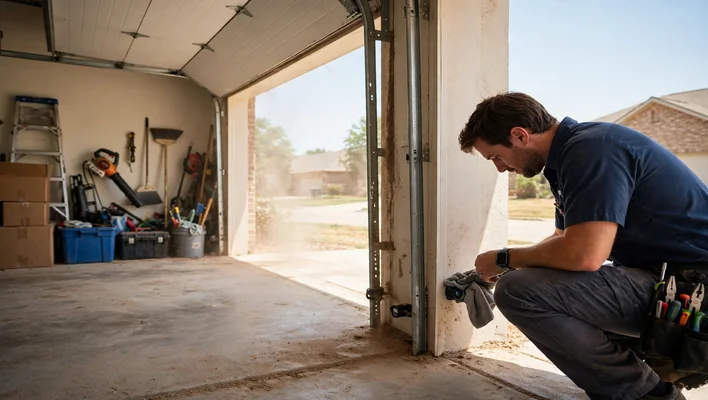
A yearly check catches most garage door issues Garland homeowners face before they turn into a stuck door. A technician check covers springs, cables, drums, rollers, tracks, hinges, opener, sensors, auto reverse, and balance. A local garage door service Garland TX homeowners can call for a yearly check will test balance, sensors, and auto reverse on every visit.
When to call a technician
Call a technician at once if your door hangs crooked, drops, will not stay in place, feels far heavier than normal, has a visible gap in a spring coil, has a frayed or loose cable, or has a roller outside its track. Call at once if the opener cycles without input, smells of burning, or trips a breaker repeatedly.
Call a technician if you are unsure which group your fault falls into. A short call, with the symptom, the sound, and the door position, is enough to decide whether to stop using the door or book a planned visit. For signs that need immediate attention, see signs your garage door needs immediate repair in Garland TX.
Frequently asked questions
Why does my garage door open a few inches and then stop?
A broken spring is the most common cause. A snapped spring leaves the door too heavy for the opener to lift, and the opener stops to protect its motor. Check the spring coil from the side, without touching it, and check power and controls before you call.
Why does my door reverse when it tries to close?
Dirty, blocked, or out-of-line safety sensors cause most reversing faults. Clear the sensor path, wipe both lenses, and check that both lights stay steady. If the sensors look clean and steady, and the door still reverses, a technician needs to test wiring, travel limits, or force settings.
What to do next: garage door repair service Garland
Most garage door issues Garland homeowners face start small. A squeak, a slow spot, a sensor light that blinks now and then, a seal that lets in a little light. Each small sign points to a part that is wearing out. Each small sign is easier and cheaper to fix than the failure it leads to.
Start with the safe checks in this guide. Check power, controls, lock mode, sensor path, and visible wear, without touching any part under tension. Stop using a door that hangs crooked, drops, feels far heavier than normal, or will not stay in place. Book a planned visit for a new noise, a slow door, a shaking door, or a door that reverses now and then.
A garage door repair company Garland homeowners call for residential garage door problems should give a written price before work starts, check the full lift system before replacing one part, and test balance, sensors, and auto reverse after the work. That full check is what keeps a repaired door running straight, quiet, and safe.
Call (214) 829-0201 for garage door repair service Garland, to reach Garage Door Repair Garland TX. Tell the team what your door does, what you hear, and where you live in Garland, so the visit can be routed well. Garage Door Repair Garland TX serves Garland, Plano, Richardson, Rowlett, and Sachse, from 2456 Belt Line Rd, Garland, TX 75044. For nearby service, see garage door repair in Rowlett TX.
Published by the team at Garage Door Repair Garland TX, 2456 Belt Line Rd, Garland, TX 75044, (214) 829-0201.